Introduction
A New Distance Is Collapsing

A few years ago, when I had an idea for a small software product, the first question was not whether the idea was good. It was whether I had enough energy to drag it through the machinery required to find out.
That machinery was familiar: write notes, sketch a flow, translate the idea into requirements, wait for a gap in someone else's calendar, explain it again, lose half the nuance, then decide whether the first version was worth the cost. Many ideas never reached the point where they could fail honestly. They failed earlier, in the waiting room.
The change I care about in this book is that this distance is shrinking. Not disappearing. Shrinking.
When I worked on MemoriA, an AI companion platform on Cloudflare, I could move from a half-formed feature idea to a clickable memory prototype in a day. It was not good enough. The recall was messy, the interface was rough, and the storage design was too clever for its own good. But it existed. I could inspect it, argue with it, delete parts of it, and make a better decision because the thing was in front of me.
That is a different kind of leverage from "AI writes faster text" or "AI writes faster code." The important change is that intention can now travel much further before it has to become a meeting, a budget request, or a ticket in a queue.
This Is Not Mainly a Book About Models
I use the term agentic AI carefully because it points to the operating change. Generative AI produces outputs. Agentic systems take a goal, use tools, work through intermediate steps, and return something a human can review. That distinction matters because the market is moving past autocomplete. It is trying to build delegated execution.
But this is not a model catalog. The models will change while this manuscript is still warm.
The more durable question is what happens to work when execution becomes easier to start. Who gets to test an idea? Who gets to show a prototype instead of asking for permission to explore? Who can turn domain knowledge into something observable before a large team gets involved?
Those questions are less glamorous than benchmark charts, but they are closer to the real shift.
Where Human Value Moves
I do not think this moment makes human judgment less important. My experience is the opposite. The easier it becomes to produce, the more expensive bad direction becomes.
When output was scarce, a lot of status gathered around production. Could you code it? Could you make the deck? Could you build the workflow? Could you turn a vague request into a finished artifact? Those skills still matter. They just no longer sit alone at the center.
The scarce work is moving toward framing, taste, sequencing, review, and knowing when something is not worth building. In MemoriA, the useful part was not that a tool could generate a schema. It was deciding what kind of memory should exist at all. Should the companion remember everything? Should recall be explicit or invisible? What should be forgotten? What would make the product feel helpful instead of creepy?
No model answers those questions for you. It can help you think. It can produce options. It can build drafts. But somebody still has to decide what kind of product deserves to exist.
The New Builders Are Not Always Who People Expect
For a long time, the people who could initiate technical work with real force were mostly the people who could implement it directly or command enough resources to have it implemented. That left a lot of high-context people on the wrong side of the wall: operators, product people, researchers, consultants, strategists, founders, domain experts.
They often knew where the pain was. They just could not always turn that knowledge into proof.
AI changes that first move. A product lead can prototype a workflow before asking engineering to harden it. An operations person can test a reporting tool before turning it into a formal project. A researcher can turn a hypothesis into a small demo before looking for a team. A consultant can show a client a working sketch instead of another abstract recommendation.
This does not mean specialists disappear. The stronger version of the argument is more modest and more useful: more people can now start with substance. Specialists then enter a better conversation, because the first artifact gives everyone something concrete to inspect.
Curiosity With Tools Attached
Curiosity used to be easy to praise and hard to cash in. You could be curious about retrieval, agents, databases, evaluation, or interface design, but unless you had the technical path to explore it, the question often stayed theoretical.
Now a good question can travel. It can become a sketch, a script, a notebook, a fake dataset, a browser test, a failing prototype, a pull request. That changes the emotional economics of learning. You do not have to become an expert before touching the material. You can touch the material in order to become less naive.
The best builders I see are not the ones who treat AI as a vending machine for answers. They treat it as a way to stay in contact with uncertainty longer. They ask better questions, then force those questions into artifacts quickly enough that reality can push back.
What This Book Tries to Do
The chapters that follow are not a grand theory of artificial intelligence. They are a map of a practical shift I keep running into while building, reviewing, and discarding projects.
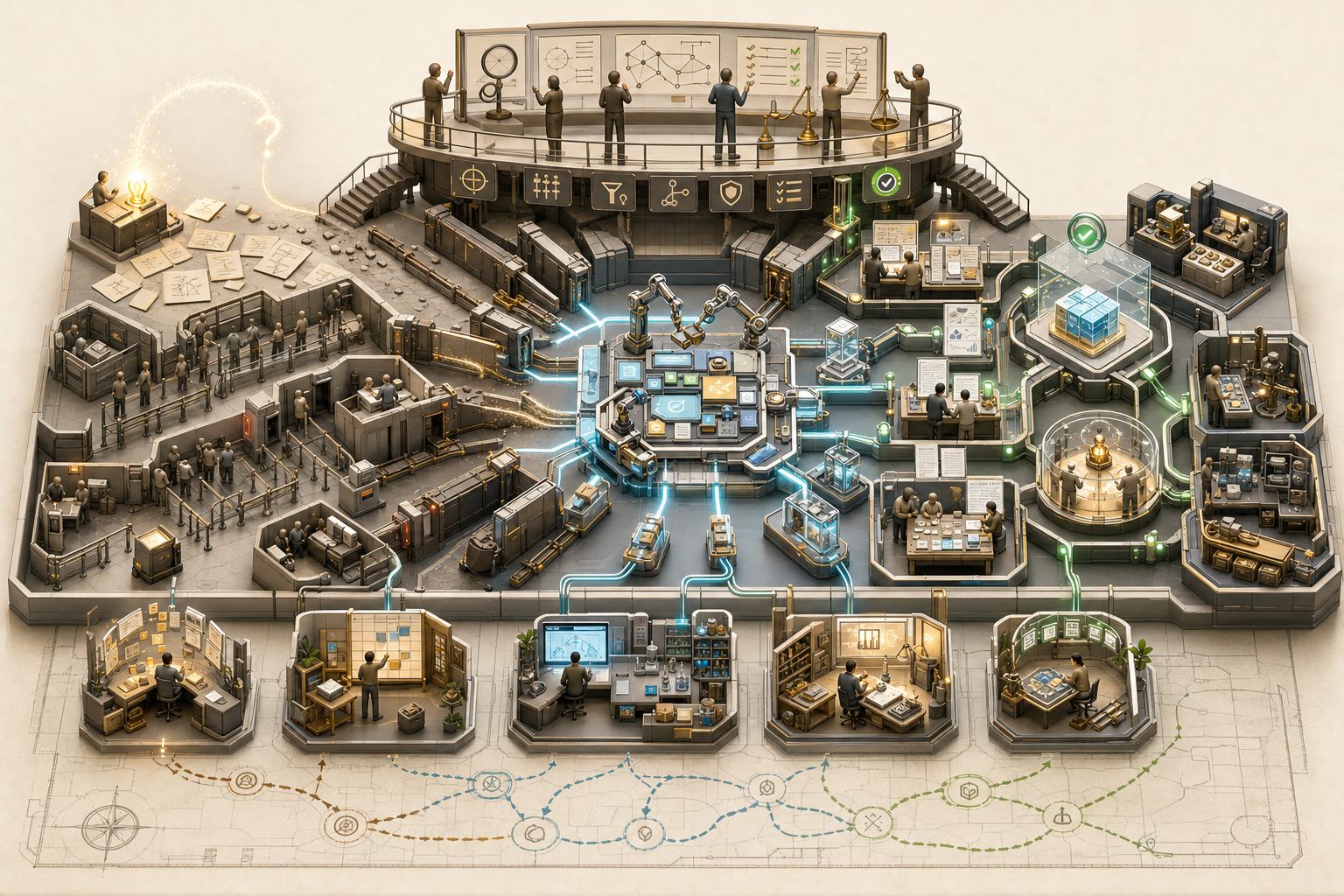
First, I look at why value moves when early execution becomes cheaper. Then I look at creativity, curiosity, decision proximity, and orchestration as working skills, not slogans. The toolbox chapter gets specific about my own stack: Antigravity, Codex, Claude Code, Notion, Obsidian, GitHub, Skills, MCP, NotebookLM, Hugging Face, Cloudflare, SQLite, sqlite-vec, and Hetzner. Later chapters slow down and talk about the loop, the traps, and the collaboration model between generalist builders and deep specialists.
The argument is not that one person can now do everything. That is fantasy, and usually a dangerous one.
The argument is that one person with judgment, context, curiosity, and the right toolchain can now get much further before the old machinery has to take over. That changes who can move first. And in many domains, moving first with something testable is already a serious advantage.
The Disclosure Is Part of the Point
This book was developed with AI support from my ideas and reviewed by me. I do not want that to be a hidden footnote. A book about human-AI orchestration should be honest about being made through human-AI orchestration.
That also raises the standard. If the prose sounds like a machine speaking in my clothes, the book fails at its own premise. The pages need to carry lived judgment: where I changed my mind, which tools earned trust, what I tried and dropped, and where I still do not know enough.
So this is the starting claim, stated plainly: AI is shrinking the distance between thought and proof. The people who benefit most will not be the ones who generate the most output. They will be the ones who can decide what deserves to be made, steer the work while it is moving, and know when a convincing artifact is still not good enough.