The Multiplication Loop
From Idea to Product With Far Less Delay
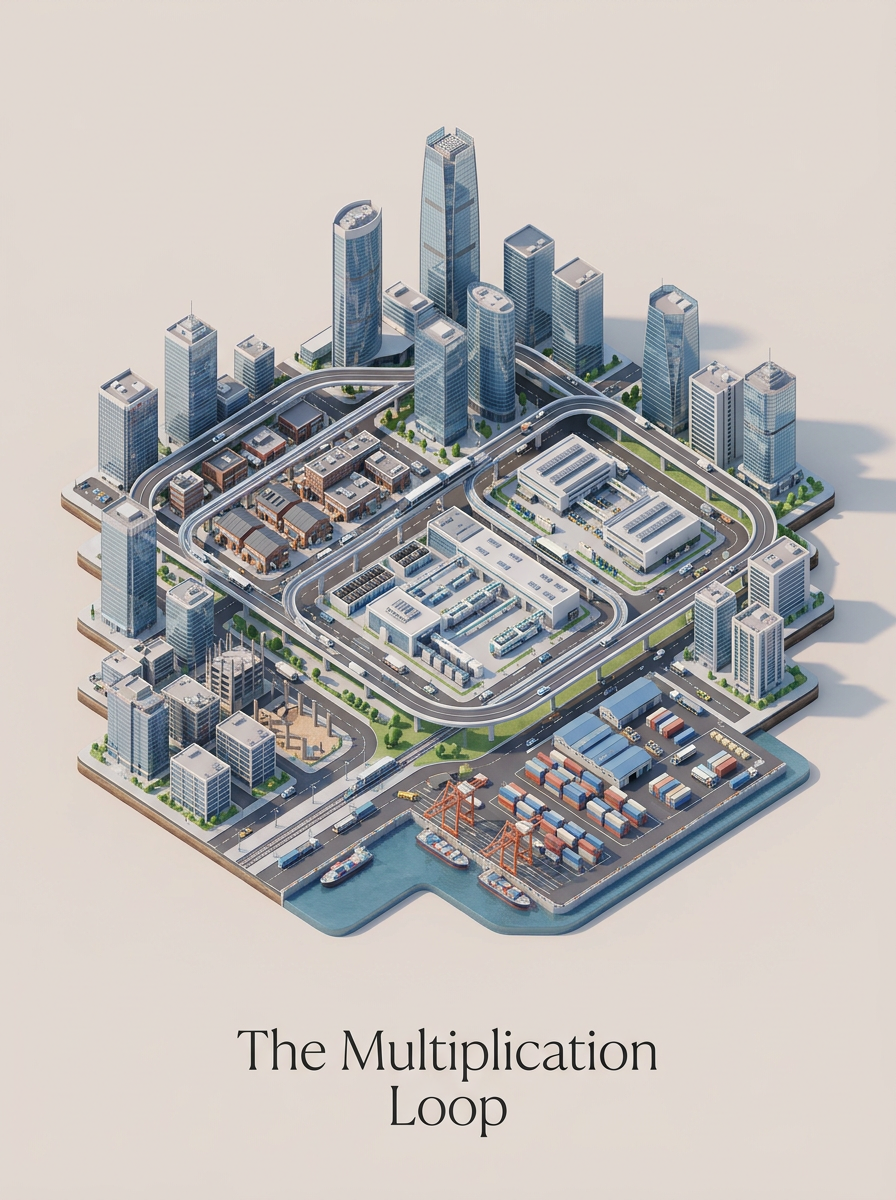
What keeps coming back to me is that the biggest leaps forward don't come from one flashy AI trick. Instead, they arise from cutting down friction across the entire journey-from the first spark of an idea all the way to the finished product sitting in users' hands.
This chapter is meant to bring that to life. Up to now, we've talked about how AI shifts leverage, how curiosity compounds, why judgment still counts, and how orchestration is becoming the new literacy. Now, I want to show the workflow not just as a list of ideas, but as a living, breathing loop.
The reason the workflow matters so much is that most stories about productivity focus narrowly on speeding up local tasks: drafting faster, coding faster, getting quicker answers. Those wins are real, no doubt. But the bigger change happens when you reduce friction all along the chain. Clarification speeds up. Drafting moves quicker. Prototyping accelerates. Deployment happens sooner. Iteration tightens. Delegation smooths out. Review cycles shorten. The improvements multiply because before, the delays were everywhere.
That's why the whole loop matters more than any single trick. One flashy move alone won't shift much. But a tighter, smoother chain? That changes everything.
The Spark
Usually, the loop kicks off with irritation.
It's rarely a grand vision right away. Not a pitch deck or a big strategy. More often, it's a small, nagging signal that something's off. A workflow feels clunky. A report takes forever. A team keeps repeating the same tedious manual step. An internal tool that should exist... just doesn't. Decisions are being made without enough clarity. A prototype would settle a debate, but no one wants to wait two months for it to move through the queue.
That tiny irritation is where a curious builder gains an edge.
In the old way, that signal might have died on the vine. It would have to be explained to the right person, translated across teams, formally documented, prioritized by someone else, and finally handed off to people far removed from the original frustration. At every handoff, some of the urgency and context slipped away.
Now, that same signal can enter the loop much earlier.
The Advisor Loop
Before there's any code, there's conversation.
This is where AI advisors come in. The builder grabs that raw irritation and starts pressing into it. What's really the problem here? Who feels it most? Would the first step be a prototype, a script, a dashboard, a workflow tweak, an internal tool, or a small automation? Which constraints are real? Which assumptions are just inherited? What would a narrow but useful first version look like?
This early back-and-forth isn't just window dressing. It compresses ambiguity.
Instead of leaping from a vague feeling straight into implementation, the builder uses this advisor loop to get clearer. The scope narrows. Alternatives get compared. Risks show up sooner. The shape of the first deliverable starts to take form. Maybe a rough architecture appears. Success criteria can be jotted down before a single line of code exists.
What I keep seeing is that this is where countless hidden hours vanish. A lot of the traditional project slowness isn't about execution-it's about unclear thinking.
The advisor loop cuts that cost.
From Draft to IDE
Once the task is clear enough, the workflow crosses a threshold. It stops being just talk and starts being action.
This is the handoff into the IDE, the repo, or whatever environment shapes the prototype. A concept becomes structure. Notes turn into files. Boundaries get drawn. The first components get names.
This step is huge because the paralysis of the blank page melts away sooner than it used to. The builder isn't starting from nothing. They already have draft logic, early assumptions, a possible architecture, acceptance criteria, and maybe a rough task breakdown. Moving into execution feels less like a leap and more like turning prepared thought into something concrete.
That's why the loop feels powerful here. The dread of beginning loses its grip.
The First Functional Prototype
The real breakthrough usually isn't beauty or polish. It's just existence.
A prototype matters because it shifts the conversation from imagining to inspecting. The team doesn't have to guess what it might feel like. They can respond to what it actually does. Buttons work or don't. Flows clarify or confuse. Logic matches the decision or falls short. Data supports the use case or it doesn't.
This is where uncertainty falls apart fastest.
That's why prototyping has become so important economically. The first artifact doesn't have to be elegant. It needs to be testable. Even a rough prototype teaches. A perfect spec often doesn't.
Practically, this is where modern tools change how work feels. Instead of waiting for permission to find out if an idea holds water, the builder can create something real enough to get answers earlier.
Improvement Through Coding Agents
Once the prototype exists, the loop picks up speed again.
Now work becomes iterative. Builders ask coding agents to refine interfaces, add features, rewrite fragile parts, explain tricky flows, tighten components, improve data handling, or explore alternatives. What used to be a stop-and-start slog of manual edits becomes a quicker rhythm of propose, inspect, change, test, and refine.
This is where "vibe coding" can both help and hurt. It helps because fast iteration lowers the cost of exploring inside the build. It hurts because moving fast can give a false sense of solidity. The builder still needs to tell the difference between motion and real progress.
The good version of this stage isn't reckless speed. It's fast iteration with review. The machine drafts, rewrites, and extends. The human keeps standards, rejects nonsense, and holds the system's logic steady.
That line is what keeps the loop productive instead of chaotic.
Deployment Creates Truth
The next big shift is deployment.
Until the system is live, a lot of uncertainty stays theoretical. But once deployed, things change. Real users interact. Real feedback flows in. Latency matters. Confusion surfaces. Real utility-or its absence-becomes impossible to ignore.
That's why deployment isn't just operational. It's epistemic. It creates truth.
In older workflows, deployment sat too far downstream to help quick learning. Too much discussion came first. Too many people had to agree. Too many boxes had to be checked before the world could answer a simple question: does this help?
The multiplication loop gets stronger because deployment can happen earlier. The builder can put a prototype on a fast platform, add a public edge, share a live link, and learn from reality-not just internal guesswork.
That's one reason progress now feels nonlinear. Earlier truth leads to better next steps.
Repo as Memory
As the work starts to feel real, memory becomes critical.
A repo isn't just where files hang out. In this loop, it becomes the project's memory layer. It holds structure, history, context, decisions, and continuity. It gives the work lasting life beyond the moment of invention.
That matters because fast workflows can otherwise slip into improvisation. Without memory, every iteration risks being a partial restart. Builders forget why they made past decisions. Collaborators can't see the path that led here. Agents lose thread. Reviews get weaker. Reuse gets harder.
The repo slows that decay. It turns speed into something that stacks up.
This is also where collaboration starts to deepen. Once work lives in a repo, other humans and agents can operate with shared reference points. The project becomes sturdier, less fragile, no longer just in one person's head.
Cloud Delegation and Pull Request Workflow
A mature loop doesn't stop once the first deployment is live. It grows.
Here, cloud delegation steps in. The builder can spin up follow-on tasks, assign them to agents, get pull requests, inspect diffs, run checks, and selectively merge improvements. Instead of AI being a single conversation that restarts from scratch every time, the workflow feels more like a managed stream of parallel contributions.
This shifts the scale of what one person can do. The builder isn't just producing work directly anymore. They're directing work, evaluating it, integrating it.
That's another reason the loop feels multiplicative. Delegation used to need people, schedules, meetings. Now, some of that delegated movement happens inside a tighter technical rhythm. It doesn't remove the need for review. It actually makes review more valuable because more branches can exist simultaneously.
Why It Can Feel Like 6x Productivity
Claims about productivity demand care. Otherwise, this can start sounding like software snake oil.
The honest truth isn't that every single task suddenly gets six times faster. It's that friction drops across the entire chain. When clarification, drafting, implementation, iteration, deployment, and delegation all speed up meaningfully, the total impact can feel several times bigger than any single local improvement.
It's a compound effect, not a magic trick.
That's why people often struggle to explain what changed. If they focus just on one piece-say, code generation-the gain sounds exaggerated. But look at the whole loop, and it starts to click. Much of modern work was slowed by countless small delays piling up invisibly. Remove enough of those, and the system acts differently.
The best way to put it is straightforward:
In well-scoped workflows, the productivity gain can feel several times larger because friction falls across the full chain, not because every task becomes proportionally faster.
That's believable. More importantly, it's useful.
The Human Role
The loop doesn't push humans out. It draws them in more deeply.
At every stage, the person still handles the essentials: choosing the problem, judging what matters, deciding scope, setting constraints, evaluating outputs, reviewing changes, and deciding what counts as done. The machine wades through more of the swamp, but the human still picks the direction and checks if the bridge holds.
So, the loop isn't about automatic product creation. It's about sustained, high-bandwidth collaboration between human judgment and machine-assisted execution.
That's the real breakthrough. Not that machines write more code, but that one person can now run a continuous loop from intuition to tested product with far less waiting.
Closing
The multiplication loop isn't a single tool. It's a sequence:
signal, clarification, draft, prototype, iteration, deployment, memory, delegation, review.
Once that sequence tightens enough, the economics of building shift. Ideas survive the early phase more often. Useful things reach reality sooner. Feedback arrives before the organization has time to bury the work in ceremonial delay.
That's why this chapter matters. It offers a concrete sense of how modern leverage actually feels when it's in motion.