The New Literacy: Not Coding, but Orchestration
The Skill That Now Matters Most
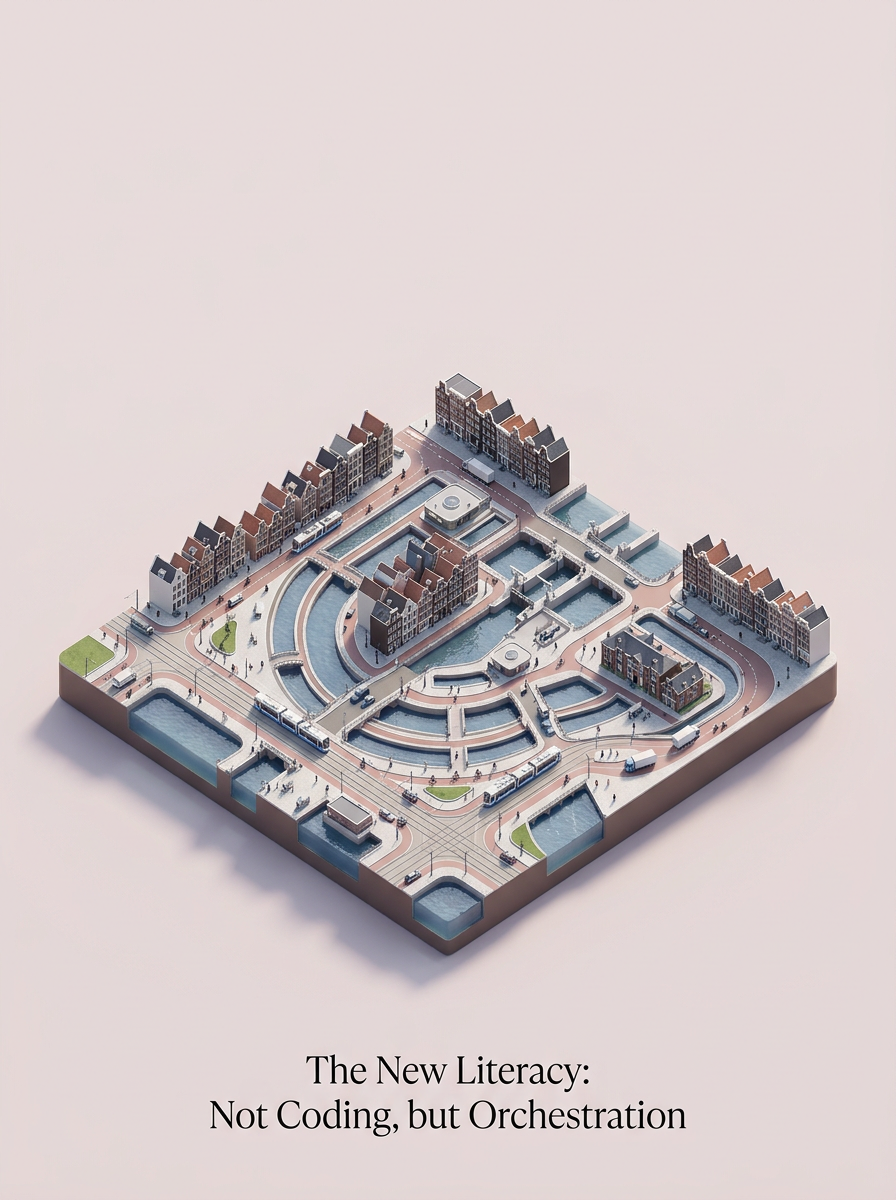
When I think about the new literacy emerging today, it's not about mastering clever prompts. It's about being able to take ambiguity and shape it into a controlled sequence of actions.
That might sound straightforward, but it's worth pausing on because the public chatter around AI often misses this point. Too many people still act like the biggest challenge is just figuring out the magic words to say to the machine. Prompting has become this kind of myth-a shortcut that lets folks avoid really thinking about how work is designed. It's flattering to imagine that a few verbal tricks will unlock huge results. But in reality, those big outcomes rarely come from words alone. They come from the structure behind the work.
What really gives someone an edge now is the ability to frame problems clearly, break them into pieces, direct tools effectively, check results carefully, and keep standards in place as the work unfolds. That's what I think of as orchestration. It might not sound as glamorous as the idea of genius prompting, but it's a lot closer to how things actually get done.
This matters because the shift to AI-native work isn't about turning everyone into coders. It's about helping more people think like orchestrators-people who design the flow of work, not just perform a small piece of it.
Prompting Is Downstream of Thinking
Prompting isn't irrelevant-far from it. But it's downstream.
What I keep seeing is that the quality of what an AI produces depends heavily on the thinking that happens before you even write a prompt. If the task is fuzzy, if constraints aren't clear, if success criteria are missing, or if the real goal is tangled up with noise, then you're basically asking the model to improvise inside confusion. Sometimes it still spits out something useful. More often, you get a polished misunderstanding.
That's why how you frame the task matters so much more than the exact wording of a prompt. Builders who consistently get good results are usually doing a lot of invisible work before they hit enter. They've already figured out what problem they're really solving. They've separated goals from preferences. They've chosen the right level of abstraction. They've defined what "good enough" actually means.
They're not just prompting-they're specifying.
That distinction matters because it shifts where the real value lives. The intelligence isn't just in the final prompt. It's in the preparation behind it.
There's also a learning side to this that I think gets overlooked. A good AI agent isn't just a tool for execution. It can also coach someone picking up a new skill. It can break down topics, suggest exercises, answer simple questions without frustration, review early attempts, and keep the learner honest about what they do and don't understand yet.
That's important because this new literacy comes from guided practice. No one becomes an orchestrator by reading a neat definition once. It happens by trying to frame a task, break down a workflow, review weak outputs, fix the structure, and try again. AI agents can stick close to that early loop and help more people move beyond admiration to real fluency.
Framing Is the First Multiplication Step
Framing is about deciding what the work actually is before you start figuring out how to do it.
It sounds obvious, but I see so many workflows fall apart here. Teams often start at the wrong place. They ask for a dashboard instead of clarifying the question that dashboard needs to answer. They ask for an agent instead of identifying the bottleneck it should remove. They ask for a feature instead of defining what behavior change that feature should produce.
Bad framing creates expensive noise down the line. Good framing cuts through it early.
This is why the new literacy isn't just technical-it's conceptual. People who can clearly define the problem add value before any code is written. They create a structure that makes tools useful. Without that structure, AI often just amplifies the existing ambiguity.
A strong frame usually includes a few essentials:
- The real objective
- The boundaries of the task
- The constraints that matter
- The risks that matter
- The criteria by which the result will be judged
Once those are clear, the rest of the workflow becomes easier to guide. The machine has a destination. More importantly, the human has something solid to review against.
Decomposition Turns Complexity Into Motion
Once the task is framed, the next skill is decomposition.
Most valuable work is too messy to tackle as one big lump. "Build the product" is too vague. "Create a customer support tool" is too broad. "Set up an agentic workflow" hides many smaller decisions inside-design, data, logic, architecture, evaluation, deployment, permissions, failure modes, monitoring, documentation, maintenance.
Decomposition is what transforms AI from a toy into something useful at scale. It breaks a big goal into distinct parts that can be assigned, checked, and recombined.
Why does this matter? Two reasons. First, smaller tasks tend to produce better outputs. Second, smaller tasks are easier to verify. Both are key.
When I see a builder who can decompose well, I know they're not just making the model's job easier. They're creating a workflow that can handle reality. They decide where judgment needs to stay centralized, where things can happen in parallel safely, where review gates belong, and which parts can be delegated without inviting chaos.
This is the opposite of what I call automation theater. It's not the fantasy that the machine will figure everything out if you ask nicely enough. It's the discipline of turning a big, fuzzy ambition into smaller pieces with clear interfaces.
Review Is Not Cleanup. It Is a Superpower
So often, review is treated as the boring chore after the "creative" part is done. But in AI-native work, review is one of the biggest sources of leverage.
Being able to look at generated output, spot weak assumptions, catch logic errors, notice security risks, weed out decorative fluff, and tighten the work into something trustworthy-that's not secondary. It's central.
This is why the human role doesn't vanish; it moves up.
When output becomes cheap, selection becomes more valuable. When variation is abundant, standards become more valuable. When you can produce many drafts quickly, the skill of telling a solid draft from a plausible fake becomes a key advantage.
This applies across the board-prose, code, architecture, research, strategy, operations. Review isn't just quality control; it's direction control. It decides which possibilities get to live.
So critique is a productive skill, not a negative personality trait. The builder who can say, "this doesn't solve the real problem," "this is elegant but brittle," or "this seems correct but misses the acceptance criteria" is doing some of the highest-value work. They're the control system for a fast-moving, generative environment.
Tool Orchestration Is Where the Real Leverage Appears
Big wins rarely come from a single model used on its own. They come from how tools connect and flow across a workflow.
A serious builder might use one system to expand the search space, another to handle scoped tasks, a third to inspect or refactor, a fourth to package repeated workflows, a fifth to connect tools through protocols, plus infrastructure to deploy and test. The advantage isn't hidden in any single step-it lives in the transitions.
That's why I think of orchestration as a literacy-a way of reading and writing workflow itself.
An orchestrator asks questions like:
- Which tool is strongest at this stage?
- What should be done once, and what should be repeatable?
- Where does the human need to step in?
- What should be reviewed before merge or deployment?
- Which tasks can safely run in parallel?
- What information must stay stable as work moves between systems?
These aren't coding questions narrowly defined. They're operational questions. They describe how intelligence, tools, and responsibility fit together.
That's why just choosing tools isn't enough. Two people using the same model can get wildly different results-one treating it as a one-off answer machine, the other as a piece within a carefully designed system.
The Human as the Control System
The phrase that sticks with me is simple:
The human is the control system.
This doesn't mean the human does every piece of work. It means the human shapes the work, assigns it, evaluates it, and decides what counts as moving forward.
This is important because the AI conversation often falls into two extremes. One says humans still type every detail, so nothing's really changed. The other says machines are the real workers now, and human judgment is just decoration. Neither is quite right.
A better way to think about it is control rather than manual dominance.
In a high-leverage workflow, humans often do less direct production of individual parts, but more design of the system that produces those parts. They set scopes, define standards, choose interfaces, read outputs critically, escalate risks, and decide when a result is good enough to proceed.
That's not a smaller role. It's a more strategic one.
Why This Changes Who Can Build
This shift is important socially and economically because it changes who can be an effective builder.
In the old model, many people with deep context were stuck on the wrong side of translation. They could see the problem clearly but had no practical way to make it happen. Now, people who can frame work, break it down, orchestrate tools, and keep standards can reach much further into execution.
This doesn't erase the need for deep specialists. It shifts the boundary between starting work and diving deep. More people can now initiate with real substance. Specialists still matter when systems need architecture, robustness, scale, security, and long-term coherence. It's not about no expertise-it's about moving from rigid dependence to more distributed capability at the front end.
That's why this new literacy matters. It's not just a personal skill. It's part of how leverage is getting redistributed.
Closing
The advantage won't go to whoever churns out the most output. It will go to those who can guide, test, and refine that output into something trustworthy.
That's the real literacy of this era. Not dazzling prompts. Not a shallow show of technical fluency. Orchestration.
The builder who can frame the work, break it down, direct the tools, review the results, and keep standards has learned the skill that matters most now. They don't just ask for output-they create a system where useful output can happen on purpose.